Paul Luckraft is a London-based curator with experience across a range of organisations. He currently Head of Programme and Artist Liaison at Gazelli Art House, London. Recent exhibitions include Subject to Change, Gazelli Art House, London (2025), Parallel Worlds, Gazelli Art House, Baku, Azerbaijan (2024) and a major commission by Libby Heaney for Frieze Sculpture 2024, Regent’s Park.
Prior to this, Paul was Senior Curator at Zabludowicz Collection, London, where he contributed to a programme with a particular focus on Art & Technology and commissioning new work. Noteworthy solo exhibitions include LuYang (2022), Shana Moulton (2019) and Rachel Maclean (2018), alongside the group exhibitions Among the Machines (2021), You Are Looking at Something That Never Occurred (2017) and Emotional Supply Chains (2016). Additionally, Paul led the Invites programme, which offered opportunities to emerging UK-based artists.
Stephen Wolfram is the creator of Mathematica, Wolfram|Alpha and the Wolfram Language; the author of A New Kind of Science; the originator of the Wolfram Physics Project; and the founder and CEO of Wolfram Research. Over the course of more than four decades, he has been a pioneer in the development and application of computational thinking—and has been responsible for many discoveries, inventions and innovations in science, technology and business.
Based on both his practical and theoretical thinking, Wolfram has emerged as an authority on the implications of computation and artificial intelligence for society and the future, and the importance of computational language as a bridge between the capabilities of computation and human objectives. He writes regularly about his activities and thinking on his Stephen Wolfram Writings site.
Professor Milton Mermikides is a composer, guitarist, academic, technologist and educator obsessed with how music works (the nature of music) and how music can help understand and engage with the wider world (the music of nature). He is Professor of Music at the University of Surrey, Professor of Jazz Guitar at the Royal College of Music, Senior Research Fellow and Composer-In-Residence of the Centre of Eudaimonia and Human Flourishing (University of Oxford), and the 37th Gresham Professor of Music – a historic post founded in 1597 whose previous incumbents include John Bull, Iannis Xenakis and Joanna MacGregor.
Milton has collaborated with John Williams, Brian Eno, Tim Minchin, Evelyn Glennie and Peter Zinovieff and has given keynote lectures and public events at the Royal Musical Association, the Science Museum, the Smithsonian Institute, The Design Museum, The British Sleep Society, the Royal Society of Medicine, and the Royal Physiological Society.
Professor Mar Morosse is based at the Weissman School of Arts and Sciences at Baruch College (CUNY), New York. She received her doctorate in Art History from the Université de la Sorbonne and brings extensive international experience across academia, curatorial practice, and the art market. She previously served as Senior Art Director to the Spanish Royal Trust, led her own art direction consultancy, and worked at Sotheby’s in New York. She has organised numerous exhibitions, including a project on Salvador Dalí’s early years for the Fundación Residencia de Estudiantes and at La Maison de la Monnaie in Paris.
Mar’s research and teaching focus on early modern European art. She currently serves as Chair of the International Committee of Artists and Designers of the College Art Association. She was a panellist at EVA Berlin (2025 and 2026), where she addressed the impact of artificial intelligence and new technologies on art history and its teaching.
Astryd Park is an engineer, artist and writer whose innovative artistic practice, academic research and product/experience development are informed by an exciting mix of art, science and technology. Their work has been presented in various locations, including most recently, London Tech Week, the Science Gallery London, and Berlin Science Week. Currently a Quantum Applications Engineer at Moth, their role involves leading creative and practical quantum software product development while outside work, their research spans kinetic sculpture, moving images and tangible experience drawing on Philosophy, Physical computing, Neuroscience and Quantum computing.
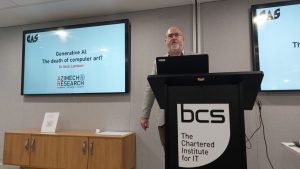
Dr Nick Lambert is an art historian in the area of digital art and culture, researching digital preservation and the art status of computational images.
He did his doctoral thesis on the history of computer art with Professor Martin Kemp at the University of Oxford (2003), and worked with Professors Charlie Gere and Paul Brown on the CACHe Project at Birkbeck, University of London, to recover the history of British computer art. The archives located through this project are now preserved in the Digital Art & Design collection at the Victoria & Albert Museum. Subsequently, Nick was PI on the AHRC Computer Art & Technocultures project with Douglas Dodds from the V&A.
Nick was Chair of the Computer Arts Society, between 2010 and 2022; and Lecturer in Digital Culture at Birkbeck, University of London, where he worked within the VASARI Research Centre for Art & Technology. He became Head of Research at Ravensbourne University London in 2015. From 2022 onwards he has been based at the University of South Wales.
Nick is also an Associate Research Fellow at the VASARI Centre in Birkbeck, a Fellow of the Royal Society of Arts and a previous judge of the Lumen Prize for Art & Technology.